|
Epicor's
Mid-Market Pitch Becomes Higher
For (One) Scala
Part One: Event Summary
P.J.
Jakovljevic
- December 13, 2004
Event
Summary
While
the market has for some time
been buzzing about the (for
many still miraculous) predatory
comeback of SSA Global,
another true mid-market incumbent
vendor, Epicor Software
Corporation (NASDAQ:
EPIC), should be lauded too
for its recent revival. Like
SSA Global, and intriguingly
in the same time frame, Epicor
did not have much upbeat news
for several years following
on its progenitors’
(i.e., erstwhile Platinum
Corporation and Dataworks)
merger in 1998 and subsequent
name change from Platinum
to Epicor in 1999. Nevertheless,
in the past two years, Epicor
has seemingly achieved a turnaround
both in terms of its financial
performance and of its strategy
clarity. It has also for over
two years reverted to its,
this time possibly more selective,
acquisition streak starting
with the Clarus
e-procurement acquisition
at the end of 2002, and former
ROI Systems
and TDC Solutions
acquisitions mid-2003 (for
more information, see Epicor
Picks Clarus' Bargain At The
Software Flea Market
and Epicor
Conducts Its Own ROI Acquisition
Rationale).
As
highlighted in the above articles,
it appears this time though
that Epicor has learned some
hard lessons from its cumbersome
inception through mergers
that had initially resulted
in unrelated, diverse products,
and all in the face of the
overall weakness of the enterprise
resource planning (ERP)
market during 1999 and 2000.
Thus, the Scala
merger too seems to have much
of a strategic merit as opposed
to a knee-jerk, ‘me
too’ impulse owing to
the ongoing consolidation
craze in the market. While
customers want their enterprise
applications providers to
oblige them with new products
and technologies, vendors
in turn feel compelled to
increase revenues and market
share as to be able to justify
funding of new product development.
To
that end, Epicor
pledges to continue
to invest in its
products and to
grow both organically
and through acquisitions,
in order to assemble
the right mix
of back-office,
front-office,
and collaborative
e-business functions,
delivered under
a single-point
accountability
(i.e., “one-stop
shop” and
“one throat
to choke”)
approach that
is overwhelmingly
desired by its
target market.
While in the past
Epicor would integrate
with partner products
for best-of-breed
solutions to accommodate
these requirements,
it has lately
been expanding
the boundaries
of traditional
ERP by building
fully integrated
applications that
are based on the
same technology
and toolsets,
and possibly delivered
all from a single
vendor.
Epicor
Acquires Scala
Accordingly,
back at the end
of 2003, Epicor
and Scala
Business Solutions
(Euronext: A.SCALA),
an Amsterdam,
the Netherlands-based
provider of collaborative
enterprise software
for mid-size enterprises
and subsidiaries
of global corporations,
jointly announced
that the expectation
was justified
that they would
reach agreement
on a merger. The
proposed merger
was effected by
a public offer
by Epicor for
all the outstanding
ordinary shares
in the capital
of Scala at an
anticipated aggregate
transaction value
of approximately
$87 million (USD)—the
equivalent of
Euro3.27 per ordinary
share—,
as of the closing
price on November
13, 2003, consisting
of a cash price
of $ 41.7 million
(USD) subject
to adjustment,
plus 4.1 million
shares of Epicor’s
common stock.
The offer was
made up of a cash
price of $1.823
(USD) per Scala
share plus 0.1795
shares of Epicor’s
common stock.
The
public offer only
commenced following
the completion
of Epicor’s
due diligence
investigation
of Scala, the
receipt of a fairness
opinion by Scala,
regulatory approvals,
the filing of
an S-4 registration
with the Security
and Exchange Commission
(SEC) by Epicor,
and other customary
conditions including,
among others,
material adverse
changes to Scala
and management
retention agreements.
Initially, Epicor
anticipated that
it would begin
the public offer
for all outstanding
ordinary shares
of Scala and publish
an offer memorandum
in December 2003,
and close the
transaction in
the first quarter
of 2004. The combination
was then also
expected to be
accretive to Epicor’s
Generally Accepted
Accounting Practice
(GAAP) earnings
in the second
quarter of 2004
and for the fiscal
year 2004.
One
of the requirements
for delisting
Scala’s
stock on the Dutch
exchange was that
at least 95 percent
of the ordinary
shares of Scala
are offered. As
said earlier,
the anticipated
transaction value
of approximately
$87 million (USD)
was to be paid
partly in cash
and partly in
Epicor common
stock, with a
20 percent downwards
protection for
the shareholders
of Scala. Any
decrease in the
value of the common
stock of Epicor
below a floor
of $10.21 (USD)
per share was
to be compensated
in cash by an
adjustment in
the offer price.
The anticipated
transaction price
of approximately
$87 million (USD)
represented a
premium of approximately
40 percent as
of the closing
price of Scala’s
shares on November
13, 2003, and
a 59 percent premium
on the basis of
the 30-day share
price average.
The closing of
the transaction,
which was expected
to occur in early
2004, was subject
to certain conditions
including, but
not limited to,
regulatory clearance
and acceptance
by Scala shareholders,
whereas the Dutch
regulator of the
financial markets
(Netherlands Authority
for the Financial
Markets) and Euronext
had been informed
of the intended
bid. SG
Cowen Securities
Corporation was
adviser to Epicor
and Fortis
Bank Corporate
& Investment
Banking
was adviser to
Scala, with respect
to the transaction.
However,
the acquisition
closing process
was delayed for
one major reason,
which was the
ensued restatement
of Scala’s
US GAAP financial
figures by its
auditor KPMG,
so that it was
not until mid-June
that Epicor was
able to declare
its public offer
to acquire all
issued and outstanding
ordinary shares
in Scala unconditional.
As of the tender
closing date,
approximately
21.7 million Scala
shares have been
tendered into
the offer, and
upon the delivery
of these Scala
shares, Epicor
was to hold approximately
93.2 percent of
the issued share
capital of Scala.
Epicor then conducted
a subsequent tender
period for holders
of Scala shares
who had not yet
tendered their
shares, which
expired effective
July 5. Following
the completion
of that subsequent
tender period
and the tendering
of 1,096,048 shares
in the period,
corresponding
with approximately
4.54 percent of
all outstanding
Scala shares,
Epicor now holds
a total of approximately
97.98 percent
of all outstanding
Scala shares.
Consequently,
Euronext Amsterdam
N.V. then confirmed
that the listing
of the Scala shares
on the official
market of Euronext
Amsterdam N.V.
would terminate
as of July 13,
2004, whereby
July 12, 2004
was the last trading
day of the Scala
shares on the
Euronext exchange.
What
the Merger Creates
The
merger by all
accounts creates
the largest independent
global mid-market
provider of collaborative
ERP, customer
relationship management
(CRM), and supply
chain management
(SCM) applications
based on Microsoft’s
.NET
platform and Web
services, with
approximately
$250 million (USD)
annual revenue
run rate, nearly
1,500 employees,
and with over
20,000 customers.
The combined company
hopes to expand
its global presence
with worldwide
coverage of sales,
consulting, and
support for mid-market
and large multinationals
as well as local
enterprises, offering
a broad suite
of integrated
solutions.
Both
Epicor and Scala
customers should
now be served
by a global entity
with the reach
and scale to more
effectively support
their operations,
and will be well
positioned for
growth with local
support in emerging
markets, and in
key markets where
Scala traditionally
performs well,
such as Scandinavia,
Russia, Central
and Eastern Europe,
and China. Scala’s
customer base
is predominantly
European , while
Epicor’s
largest customer
base predominantly
in North America,
Australia, and
the UK. The resulting
company’s
revenues will
therefore be diversified
across regions
with approximately
52 percent of
its revenue base
in North America
and 48 percent
outside this region.
The
combined company
plans to further
support and develop
iScala
products, while
Scala’s
management was
offered one board
seat out of six
on Epicor’s
board of directors.
In the long term,
the combined company’s
product offering
would be developed
using the functional
synergies of all
products, and
the integration
advantages of
the .NET framework
and Web services.
Enlarged Epicor
pledges to continue
the unwavering
commitment to
developing and
bringing to market
software and services
based on Microsoft
technology, given
its strong Microsoft
partnership—as
a globally managed
independent
software vendor
(ISV) and Microsoft
Global ERP Ecosystem
partners—and
has actively participated
for many years
in numerous Microsoft
joint development
programs and early
adopter technology
initiatives.
The
merger may also
bode well for
Epicor’s
expanded presence
in key growing
verticals including
financial services,
consumer packaged
goods (CPG),
professional services,
automotive, industrial
machinery, light
engineering, electronics,
hospitality, pharmaceuticals,
and nonprofit.
Also, this might
increase the vendor’s
scale and reach
to support global
multinational
corporations with
a worldwide infrastructure
for sales, consulting,
and support, and
a strong partner
channel—combining
over 400 partners
worldwide, with
possible operating
and infrastructure
synergies in general
and administrative
(G&A), research
and development
(R&D), facilities,
and technical
support with a
solid platform
and infrastructure
for future strategic
and tactical acquisitions
in a consolidating
market.
Prior
to the merger,
Epicor had delivered
its solutions
to over 15,000
customers worldwide,
whereby its manufacturing
customer community
includes over
6,500 customers,
implemented in
more than thirty-five
countries. Epicor's
broadening suite
of integrated
software solutions
features CRM,
financials, manufacturing,
SCM, professional
services automation
(PSA), and collaborative
commerce applications.
On
the other hand,
Scala’s
main trump is
unrivaled localization
capabilities for
companies doing
business in established
or emerging markets,
or even in some
of the world’s
most difficult-to-get-to
places. Scala
has garnered the
local know-how
and expertise
to deliver results
for businesses
almost anywhere
in the world,
from over twenty-five
years working
with international
companies and
their subsidiaries
and divisions
in many types
of industries.
Scala delivers
software and services
that support local
currencies, accounting
regulations, and
legal requirements
in more than thirty
languages in over
140 countries.
Epicor
Financials
Since
the transaction
closing, Epicor
has reported two
quarters of earnings,
most recently
the October 20
upbeat announcement
of financial results
for the third
quarter ended
September 30,
2004. For a protractedly
languishing company
until not that
long ago (see
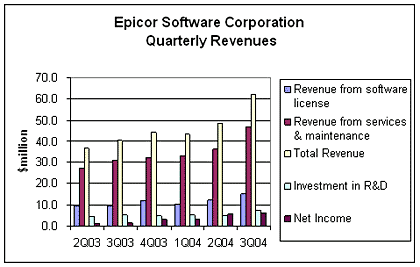
figure 1), reporting
facts like that
the Q3 2004 revenues
grew over 54 percent,
year-over-year,
whereby Q3 2004
license revenues
grew over 64 percent,
year-over-year,
second quarter
GAAP earning
per share
(EPS) grew over
whopping 175 percent,
year-over year,
while the vendor
added over 165
new customers
to its base and
it released over
50 product upgrades
to market across
its suite of solutions,
and so on, should
bear a great importance
and vindication
to the long-embattled
but persistent
management.

Figure
1
Total
revenues for the
quarter were $62.2
million (USD),
up over 54 percent
compared to $40.3
million (USD)
for Q3 2003, whereby
it included $17.5
million (USD)
in total revenues
from Epicor’s
recently acquired
subsidiary Scala
Business Solutions
N.V., whose revenues
have fully contributed
for the first
time to this quarterly
report. Excluding
the contribution
from Scala, Epicor’s
total revenues
grew 11 percent
year-over-year.
Software license
revenue totaled
$15.3 million
(USD), a 64 percent
increase compared
to $9.4 million
(USD) a year ago
and including
$4.7 million (USD)
for the contribution
from Scala (see
figure 2). Excluding
the contribution
from Scala, Epicor’s
license revenues
grew approximately
13 percent year-over-year.
Figure
2
Consulting
and maintenance
revenues for the
third quarter
were $45.9 million
(USD) compared
with $30.4 million
(USD) in the third
quarter of 2003,
up over 50 percent.
Included in consulting
and maintenance
revenues was $12.6
million (USD)
from Scala’s
contribution.
Excluding the
contribution from
Scala, Epicor’s
consulting and
maintenance revenues
grew approximately
10 percent year-over-year.
GAAP net income
for the third
quarter was $6.3
million (USD),
which compares
with net income
of $1.8 million
(USD) in the prior
year’s period.
For the quarter,
adjusted earnings
were $9.6 million
(USD) compared
with adjusted
earnings of $4.7
million (USD)
in the same period
last year. Adjusted
earnings exclude
amortization of
capitalized software
development costs
and acquired intangible
assets, stock-based
compensation expense
and restructuring
charges, and other.
Further,
Epicor ended the
quarter with cash
and cash equivalents
of $46.6 million
(USD), up approximately
2 percent from
the prior quarter,
including significant
cash expenditure
for transaction
costs, Sarbanes-Oxley
costs, and severance
costs following
the reduction
in force completed
during the quarter
as a result of
consolidating
the Epicor and
Scala organizations.
For
the fourth quarter
2004, the company
raised its previously
issued total revenues
expectations from
the range of $66
to $67 million
to $67 million
(USD) in total
revenues, while
for fiscal year
2004, the company
raised its previously
issued total revenue
guidance of $220
million to $221
million (USD).
Additionally,
the company provided
an initial outlook
for fiscal year
2005, where it
anticipates the
revenues to be
approximately
$273 million (USD)
The company has
also completed
extensive operational
reviews of its
Scala acquisition
and put in place
plans toward achieving
its cost synergies
and accretion
goals, which was
demonstrated in
the last quarter.
How
Scala Complements
Epicor
Epicor
Software Corporation
(NASDAQ: EPIC)
and Scala
Business Solutions
(formerly Euronext:
A.SCALA, delisted
in July 2004),
an Amsterdam,
the Netherlands-based
provider of collaborative
enterprise software
for mid-size enterprises
and subsidiaries
of global corporations
have completed
a merger that
began in late
2003. The merger
creates the largest
independent global
mid-market provider
of collaborative
ERP, customer
relationship management
(CRM), and supply
chain management
(SCM) applications
based on Microsoft’s
.NET
platform and Web
services, with
approximately
$250 million (USD)
annual revenues,
nearly 1,500 employees
and with over
20,000 customers.
The combined company
has an expanded
global presence
with operations
and customers
in 143 countries,
including worldwide
coverage of sales,
consulting and
support for mid-market
and large multinationals
as well as local
enterprises, offering
a broad suite
of integrated
solutions.
Given
Epicor’s
ordeal of the
past and the fact
that divesting
two lateral products
in 2001 greatly
helped it achieve
some much needed
stability nowadays
(see Latest
Development on
Epicor's Trying
The Divestiture
Tack),
one could wonder
about the wisdom
of the renewed
Epicor’s
appetite for acquisitions.
After all, the
acquisition of
former Dataworks
had left Platinum
(subsequently
Epicor) with multiple
unrelated ERP
products and the
inherited daunting
task of rationalizing
its product development
strategy, and,
who on earth with
a sound mind would
like to revisit
that experience?
Well, concurrently
with achieving
a turnaround both
in terms of its
financial performance
and of its strategy
clarity, Epicor
has also for over
two years reverted
to its, this time
possibly more
selective, and
thus successful
acquisition streak
starting with
the Clarus
e-procurement
acquisition at
the end of 2002,
and former ROI
Systems
and TDC
Solutions
acquisitions mid-2003
(for more information,
see Epicor
Picks Clarus'
Bargain At The
Software Flea
Market
and Epicor
Conducts Its Own
ROI Acquisition
Rationale).
Moreover,
one should note
that Epicor has
since its progenitor’s
inception twenty
years ago been
competing primarily
in the true mid-market,
which it defines
as enterprises
with revenues
between $50 million
and up to $1 billion
(USD), and to
that end, the
vendor has competed
mainly with the
Vantage
(for new business
opportunities),
Manage
2000,
and Avanté
products in the
manufacturing
arena, and with
the Epicor
Enterprise
suite (formerly
e by Epicor)
and the Clientele
standalone CRM
product for certain
service industries.
Increasingly,
since customers
in this mid-market
segment are looking
for Microsoft
SQL Server-based
solutions, the
Vantage manufacturing
product (and its
“smaller
sibling”
Vista,
as an introductory-level
product) have
turned out as
better positioned
to address this
requirement, although
both major manufacturing
product lines
include the broad
range of modules
for the upper
echelon of midsize
manufacturing
enterprises.
Scala
Products
Therefore,
Scala should complement
and further bolster
Epicor’s
offering in many
regards, but possibly
the royal one
would be its ability
to firmly position
Epicor as a standardized
tier 2 or divisional
solution for Global
1000 companies.
This is owing
to Scala’s
unrivaled global
product capabilities
amongst peer vendors,
which will be
explained in more
detail later in
the text. Otherwise,
at first glance
the merger looks
like a positive
move for both
companies and
their customers,
since Epicor obtains
a foothold in
some complementary
geographic regions,
and in certain
discrete manufacturing
and service industries
where it has not
really penetrated
in the past (e.g.,
industrial machining,
pharmaceuticals,
light engineering,
hospitality, retail,
not-for-profit
[NFP] organizations,
etc.) by acquiring
a reasonably run
vendor without
much excessive
baggage.
It
is interesting
to note that during
Epicor’s
trying years at
the turn of the
century Scala
had performed
much better. For
example, although
the market turbulence
during these few
years had also
taken its toll
in Scala’s
restructuring
and cost-containment
exercise, still,
with revenue of
approximately
EUR 74 million
in 2002, which
was a slight 4
percent growth
over 2001, Scala
then remained
a prominent mid-market
enterprise applications
provider. Although
its license revenue
declined by 7
percent in 2002,
the maintenance
revenue increased
by 23 percent,
given that more
than 90 percent
of existing customers
continued to pay
for maintenance.
This was, in part,
due to an aggressive
development program,
which saw the
release of iScala
2.1 in
mid-2002 (see
Scala
Shows Far More
Than a Bit of
a Backbone)
and a newer version
iScala
2.2 in
2003. From 2001
to the end of
2002, the company
also doubled its
research and development
(R&D) headcount
to over 200 (out
of a 700 total
employee headcount
at the time),
plus 50 development
contractors, and
geared up its
in-house training
center, the Scala
University
in Budapest, Hungary
to train and certify
its growing ranks
of 140 resellers
that accounted
for 23 percent
of its business
in 2002.
But,
despite impressive
growth and cash
flow during these
years, Scala unfortunately
posted a quite
disappointing
performance in
early 2003, possibly
at an unwanted
time, resulting
with a restructuring
program that included
rationalization
of the company’s
bloated R&D
base with the
closure of some
satellite R&D
facilities and
the transfer of
expertise to the
company’s
cost-effective
center of technical
R&D excellence
in Moscow, Russia,
and headcount
reduction of approximately
30 percent from
the previous employee
level, including
consolidation
of a number of
senior management
positions.
Possibly
more disconcerting
was the fact that
long-standing
customer interest
in the new functionality
of Web services-enabled
iScala 2.2 release
then resulted
in overcommitment
to customer-related
developments (whereas
the iScala 2.1
release was mainly
focused on improvements
in the underlying
technology platform).
As a result, the
commercial release
had to be delayed
to September 2003
instead of previously
indicated mid-2003.
This delay created
a vicious circle-like
adverse impact
on new license
sales, as customers
had to wait for
new functionality.
Even as all these
events took place
at possibly the
worst time for
Scala,,Epicor,
who struggled
at the turn of
the century, had
ironically meanwhile
quite straightened
its ship to even
appear attractive
as a savior to
former Scala board
in 2003.
Also,
these rationalization
measures and the
eventual release
of the product
have reverted
to increased revenues
and a positive
operating income
afterwards. Namely,
by the end of
2003, Scala’s
results were again
exceeding expectations
owing to a new
product released
in September,
iScala
2.2 Collaborative
ERP,
which was hailed
as the biggest
release of new
functionality
in more than 10
years, and which
has several modular
or individual
enhancements of
interest to manufacturers,
including service
management, CRM,
SCM, asset management,
contract management,
resource management,
business intelligence
(BI), workflow
management, user
interface
(UI) customization,
and connectivity.
The
company has since
reportedly seen
strong customer
demand for the
new iScala version,
reflected in its
healthy sales
pipeline, especially
in markets where
Scala traditionally
performs well,
including Scandinavia,
Eastern Europe,
Russia, and China.
Nearly 60 percent
of Scala’s
top customers,
including both
global and local
enterprises, have
supposedly been
actively involved
as early adopters
since 2002, with
many of them already
running the new
version live.
As an example,
Tetra
Pak is
one of Scala’s
longest-standing
customers, with
Scala solutions
implemented in
nearly fifty countries,
against SAP
at the corporate
level.
iScala
2.2
The
iScala 2.2 Collaborative
ERP system includes
- iScala
Core Business
Processes,
which is a set
of business
processes that
includes multicurrency
and multi-legislative
financial functionality,
asset management,
and a set of
packaged integration
solutions (eXtensible
markup language
[XML]-electronic
data interchange
[EDI], financials,
and master data
integration)
which helps
customers to
improve the
business efficiency
of their core
processes.
-
iScala
CRM,
which is powered
by Microsoft
CRM
(for more information,
see Scala
and Microsoft
Become (Not
So) Strange
CRM Bedfellows),
accessible from
both Microsoft
Outlook and
the Web, and
integrates with
iScala ERP and
other business
systems.
-
iScala
SCM,
which is packaged
to address typical
business needs,
starting with
logistics (purchase
and inventory
management),
warehouse management
(including quality
control), manufacturing
(planning, configuration,
shop floor control),
tools (such
as lead time
management,
available
to promise
[ATP] and drop
shipment), and
integration
solutions.
-
iScala
Contract Management,
Project
Management,
Service
Management,
which is a set
of business
processes that
has been significantly
improved and
extended in
the new version
of iScala to
help customers
automate their
pertinent business
processes.
-
iScala Human
Resource Management,
which includes
the global version
of the iScala
Payroll
module that
customers can
use to improve
their personnel
management in
almost any country,
regardless of
how complex
the legislation
requirements.
-
iScala Business
Intelligence
(BI) Server,
which provides
a broad set
of BI and analytics
tools to give
users access
to information
they need when
they need it
to make the
right decisions
quickly. Designed
to make operational
and management
reporting easier,
the product
enables users
to relatively
quickly perform
drill-down enquiries
and comparative
analysis to
find out exactly
how the business
is doing and
where improvements
are needed.
-
iScala
Developer,
which is an
entire development
solution for
creating vertical
and unique company-specific
processes inside
and outside
the iScala system.
Thereafter,
in May, Scala
announced that
the first service
release (SR1)
of the latest
version of the
iScala Collaborative
ERP system is
now available
for all existing
and potential
customers worldwide.
iScala
2.2 SR1
includes a wide
range of new and
enhanced business
functionality,
such as better
connectivity with
other best-of-breed
warehouse and
manufacturing
systems, improved
features in the
supply chain and
service management
processes as well
as availability
in two additional
languages—Korean
and traditional
Chinese.
The
company has also
enhanced its iScala
CRM offering to
give customers
better visibility
into the sales
pipeline and across
sales activities,
to improve the
quality of leads
and closure rates
and be able to
fully integrate
with Microsoft
Outlook and other
Microsoft
Office
programs. iScala
CRM now comes
with standard
reports that are
reasonably fast
and easy to run
and with a familiar
interface, similar
to Outlook,
which will possibly
help a company
extend its applications
to more users.
For example, a
user can create
a sales proposal
from a Microsoft
Word template,
use pricing data
from their iScala
ERP system, and
save all versions
of that proposal
within iScala
CRM, keeping track
of all the changes
in the sales cycle
until the sale
is closed.
Last
but not least,
the addition of
a brand new iScala
Manager Software
Developer Kit
should interest
Scala’s
indirect channel,
who will now be
able to add further
value by designing
new business processes
that can easily
be added to the
standard iScala
workflow, to support
customer- or industry-specific
needs.
Market
Impact
Epicor
Software Corporation
(NASDAQ: EPIC)
and Scala
Business Solutions
(formerly Euronext:
A.SCALA), an Amsterdam,
the Netherlands-based
provider of collaborative
enterprise software
for mid-size enterprises
and subsidiaries
of global corporations,
have completed
a merger that
began in late
2003. The merger
creates the largest
independent global
mid-market provider
of collaborative
ERP, customer
relationship management
(CRM) and supply
chain management
(SCM) applications
based on Microsoft’s
.NET
platform and Web
services, with
approximately
$250 million (USD)
annual revenues,
nearly 1,500 employees,
and with over
20,000 customers.
The combined company
hopes to expand
its global presence
with worldwide
coverage of sales,
consulting, and
support for mid-market
and large multinationals
as well as local
enterprises, offering
a broad suite
of integrated
solutions.
Thus,
Scala, with main
direct office
coverage in Europe
and the Far East,
and through its
network of partners
and dealers in
most remote, esoteric,
and still low-penetrated
markets, perfectly
fits the description
of an ideal Epicor
supplement. Another
factor that may
bode well for
its future as
Epicor’s
subsidiary is
its vast international
coverage, and
a broad geographic
revenue mix (over
4,500 customers
with over 7,500
sites worldwide),
which not many
(if any) peer
vendors can tout.
Scala has offices
in over thirty
countries, with
local distributors
increasingly helping
out the direct
sales force, whereas
the vendor has
continued to offer
its products and
services through
the reseller channel
and value
added resellers
(VAR), which has
also expanded
lately, with 54
percent license
revenue growth
in 2002 and with
a 34 percent growth
in number of partners
amounting to over
140 partners worldwide.
The
above facts have
long promoted
Scala into a serious
challenger in
the mid-market,
especially in
emerging markets
like Central and
Eastern Europe,
Middle East, and
China (possibly
the local market
leader therein
following up on
the early entry
in the 1980s).
The former flagship
Scala
5.1,
a mature but less
technically apt
ERP product suite,
has traditionally
covered the full
spread of core
ERP modules, including
logistics, manufacturing,
financials, project
management, and
service management,
with the indication
of high levels
of customer satisfaction.
Like SYSPRO,
its parent-to-be
Epicor, Intuitive
Manufacturing
Systems,
and Exact
Software,
Scala’s
functionality
is equitably solid
in accounting,
manufacturing,
and material management
areas. This is
an advantage compared
to competitive
products that
are either mainly
strong in accounting
(e.g., Microsoft
Business Solutions
[MBS],
Sage/Best/ACCPAC,
Coda,
Systems
Union/SunSystems,
Unit 4
Agresso,
etc.) or in manufacturing
or distribution
(e.g., Lilly
Software,
SoftBrands,
Made2Manage,
or QAD).
Scala
Market Strategy
At
the beginning
of 2000, Scala
began redesigning
its ERP software
and building a
new platform specifically
for on-line collaboration.
It has meanwhile
packaged together
the functionality
required in one
standard software
system, which
means a business
can begin collaboration
with its subsidiaries,
customers, partners,
and suppliers.
To that end, iScala
2.1 was
the successor
product to Scala
5.1, since it
contained all
of the basic ERP
functionality
that was available
in Scala 5.1 in
addition to the
collaborative
capabilities inherent
to the new XML
Web services-based
design. Scala
5.1 was withdrawn
from new business
sales in December
2002, although
existing customers
will continue
to receive support
well into the
future.
Like
its predecessor,
iScala
2.2 also
comes in two flavors
to satisfy needs
of both local
medium business
and of smaller
global corporations
(and their subsidiaries,
divisions, and
suppliers). The
iScala
Business Server
is an entry-level
product—a
collaborative
ERP package for
the medium-size
stand-alone business
needing core ERP
functionality
without a need
for high scalability
and advanced security,
and as a first
step towards automating
business processes
across applications
and with customers
or suppliers systems.
iScala Enterprise
Server,
on the other hand,
is designed as
a more complete
collaborative
ERP package for
medium-size multinational
companies or for
the subsidiaries
and divisions
of larger enterprises.
It has all the
functionality
of the iScala
Business Server
but adds scalability,
business centralization
capabilities,
and support for
working across
and supporting
multiple sites
and subsidiaries.
Thus,
Scala prefers
not to be simply
perceived as a
mid-market vendor
per se, as it
rather targets
two somewhat distinct
mid-market segments:
1) mid-size units,divisions,
or subsidiaries
of large corporations,
and
2)
independent mid-sized
enterprises, where
Epicor’s
sweet spot has
also primarily
been so far. There
are slight variations
in the needs of
these two mid-market
types, since the
corporate divisions
typically have
urgent connectivity
needs such as
processing multinational
invoices, using
integrated warehouse
systems, or triggering
automatic purchase
and sales orders.
Unique
Multilingual Capabilities
Accordingly,
Scala has long
featured possibly
the unique multilingual
capabilities of
its Collaborative
ERP software.
Scala maintains
a single set of
application code
for all its languages—more
than thirty—compared
to other vendors
who commonly support
different software
versions for different
languages. Scala’s
product architecture,
which enables
a single version
of the software
to support multiple
languages, means
global companies
can keep their
maintenance costs
down by, for example,
running a single
service center
to support several
countries. It
also gives them
flexibility to
manage their global
business more
easily in a multilingual
and multicultural
environment, since
Scala also provides
telephone support
in over fifteen
different languages
to support local
users worldwide.
To
ensure that every
new product is
multilingual from
the start of its
life cycle, translation
into different
languages is done
in the software
development process
on a phrase-by-phrase
basis to give
accurate meaning
in multiple languages.
The multilingual
capabilities are
enhanced by the
new Unicode technology
that is used starting
with iScala 2.1,
allowing the combination
of any languages
with different
characters in
a single installation.
True multilingual
technology like
Unicode also allows
a wide range of
languages such
as Chinese, Russian,
or Arabic, to
be stored, displayed,
and printed on
the same page
or even in the
same field. The
technology also
gives Scala a
significant technical
advantage in that
new developments
and maintenance
updates to Scala
software only
have to be developed
in a single version,
whereas Scala’s
competitors typically
have to maintain
multiple versions,
one for each language.
Consequently,
having long focused
on the upper end
of the ERP mid-market,
Scala has apparently
demonstrated an
understanding
of this market’s
dynamics and its
pragmatic requirements
of robust multinational
corporate functionality
and intra-enterprise
visibility within
a fairly inexpensive
product, fast
and simple implementations,
and reliable service
and support. The
company has struck
the value proposition
of balancing business
processes standardization
with flexibility
and autonomy of
remote subsidiaries,
which should come
in handy for Epicor’s
like forays.
Global
companies should
appreciate iScala’s
features such
as simultaneous
support for multiple
accounting standards,
enhanced security
and usability
features, and
remote administration
tools to manage
distributed or
local installation,
which can often
match or exceed
the tier one vendors’
capabilities.
Many other peer
vendors conversely
require their
customers to operate
in a single language
at each location
because their
applications are
based on the technology
unable to hold
more than one
language in the
same system.
With
recently increased
business functionality,
comprehensive
integration, and
connectivity capabilities
coupled with a
brand new flashy
UI, iScala 2.2
might be an attractive
choice for companies
who are considering
upgrading or buying
a new ERP system.
There might be
no similar product
that provides
companies with
consistent information,
a global view
of the business,
one view of customers
or suppliers,
and reasonably
rapid system deployment
at the same time.
While
tier one enterprise
systems can cope
with the complex
needs of centralized
functions and
a large number
of users, they
are often not
well-suited to
handling the less
complex needs
or localization
requirements of
a branch or sales
office in remote
countries. Hence,
Scala (and now
Epicor too) wants
to cohabit with
these global players
by providing systems
for subsidiaries
and regional offices
of global enterprises.
Scala’s
argument would
be that it is
simply too expensive
and time consuming
to keep changing
a rigid tier one
product to suit
a changing market,
even if it could
be deployed in
a location where
often the poor
telecommunications
infrastructure
capability would
prevent a web-deployed
system from being
used.
Vertical
Specialization
Scala’s
endeavor at some
vertical specialization,
operating with
a wide range of
specialist channel
partners around
the world, many
of whom target
specific application
areas, such as
the pharmaceuticals
business (over
500 sites) and
the hospitality
industry (over
300 customers),
is also commendable,
although these
are perceived
and marketed as
stand-alone solutions,
separate from
iScala. Thus,
these solutions
will have to inevitably
migrate to the
new iScala platform
in a foreseeable
future. Also,
a number of Scala
customers work
in discrete engineer-to-order
(ETO) and make-to-order
(MTO) manufacturing,
and require full
project based
accounting capabilities.
Because one of
the main businesses
of these global
companies is to
manufacture in
lower cost geographic
locations, the
vendor has made
attempts to ensure
that iScala's
capabilities at
least match the
demands of the
medium to small
manufacturing
subsidiary, whether
it be for ‘to
stock’ or
‘to order’
manufacturing
environment.
Still,
independent Scala
had yet to build
or acquire many
aspects of the
extended-ERP functionality,
especially supply
chain planning
and execution
(SCP&E) and
product lifecycle
management
(PLM) functional
enhancements to
round out a complete
collaborative
extended-ERP suite,
readily available
by many of its
peers let alone
the tier one likes
of SAP,
SSA Global,
PeopleSoft,
Oracle,
Intentia,
and IFS.
Not to mention
the need to bolster
strategic supplier
relationship management
(SRM) and sourcing,
manufacturing
operational capabilities,
and shop floor
execution, well
beyond a mere
order management.
Some of iScala’s
clever features,
like Global ID
(a unique identifier
to be assigned
in all of client’s
enterprises worldwide)
and available-to-promise
inventory
(ATPI) order line
check, still could
not have been
sufficient to
comprise a holistic
SCM strategy.
Scala
Connectivity Solutions,
which are already
deployed in over
100 sites in over
thirty countries,
provide interconnectivity
to any best-of-breed
products (e.g.,
CRM, SCM, e-commerce
site integration,
warehouse
management system
[WMS], bar code
for distribution,
SAP, or personal
digital assistant
[PDA]-based module
solutions) would
likely not have
sufficed for the
target market’s
one-stop-shop
requirements.
Therefore, iScala
presents an opportunity
for third party
specialists or
VARs to create
add-on modules
providing functionality
geared to a targeted
market and meet
the specific needs
of a group of
users. Not to
mention that many
ready-made solutions
from the Epicor’s
arsenal (e.g.,
SRM, PLM, WMS,
storefront commerce,
etc.) could come
in handy for potential
up-sell and cross-sell
purposes.
Hence,
in addition to
a number of potential
functional extensions,
Scala finds a
more visible ‘big
brother’
with a global
infrastructure
(i.e., Epicor
generated nearly
$150 million (USD)
in revenue in
fiscal 2003, which
should still rank
it amongst the
dozen or so largest
enterprise applications
vendors in the
world) and a solid
management team,
more certain R&D
budgets, while
both companies
should jointly
garner increased
visibility and
clout. Both user
communities should
benefit from Epicor’s
enlarged size
(a substantial
installed base
of over 20,000
customers), and
recently restored
financial stability
and likely mutual
products’
enhancements (e.g.,
Epicor could leverage
Scala’s
HR and payroll
modules or localization
capabilities,
rather than typically
licensing them
in an original
equipment manufacturer
[OEM] fashion).
Epicor
Contribution
On
the other hand,
Epicor has embraced
.NET even more
zealously than
its creator Microsoft,
often leaving
Microsoft staffers
in their development
labs with their
dropped jaws.
As a good example,
over two years
ago, the vendor
released Clientele
CRM .NET
as a pure .NET-based
product (see Epicor
Claims the Forefront
of CRM.NET-ification).
Further, at the
company level,
Epicor’s
standardized technology
direction currently
embraces the Microsoft
.NET Platform
for XML-based
Web services.
Through .NET,
which is the next
generation of
Microsoft's
Distributed interNet
Applications Architecture
(DNA)
and Component
Object Model
(COM),
the vendor hopes
to be able to
provide comprehensive
support for Web
services deployment
and enterprise
application integration
(EAI).
This
technology strategy
should enable
Epicor's still
diverse development
teams to leverage
Microsoft technology,
while allowing
each product group
to continue using
the individual
databases and
development tools
appropriate to
the requirements
of each product's
target market.
For example, with
the release 6.0
of both the Vantage
and Vista
manufacturing
products early
in 2003, Epicor
executed on a
critical milestone
of its manufacturing
product roadmap—incorporating
a single application
framework across
the two solutions
through the alliance
with Progress
Software Corporation,
as well as with
Sonic
Software Corporation
for its enterprise
service bus for
transactions services
and security.
Furthermore,
in late 2004,
Epicor will introduce
its .NET-based
Vantage
8.0 manufacturing
solution (formerly
code named Project
Sonoma),
which features
an n-tier architecture
that has been
architected from
the ground up
to support the
.NET platform
and Web services.
Rather than wrapping
existing applications
with Web service-like
interfaces, the
new Vantage and
Vista presentation
layer has completely
been rewritten
in C# and Visual
Studio.NET,
while the extensive
business logic
has been preserved
and wrapped around
with stateless
Web services (i.e.,
which are connected
or invoked only
when the information
is needed).
The
platform will
supposedly deliver
unrivalled flexibility
and performance
for both developers
and customers,
and allow for
the development
of applications
based on Web services
that have either
a smart client
or browser-based
UI. Version 8.0
will include frameworks
for exposing all
applications interfaces
as Web services,
plus an orchestration
engine for constructing
composite applications
using both Microsoft
BizTalk Server
and Sonic.
The solution aims
at enabling all
(both existing
and future) Epicor
manufacturing
customers to adopt
Web services piecemeal,
on their own time
frame, while protecting
the existing technology
investment, since
software reuse
and integration
have been on Epicor’s
mind during the
software revamp.
Also
at the corporate
level, the vendor
has incorporated
numerous features
into its UIs to
simplify the operation
of and access
to all its products,
which incorporate
the popular Microsoft
Windows
graphical
user interface
(GUI). Epicor’s
GUI tools include
industry-standard
field controls,
pull-down menus,
tool bars, and
tab menus that
facilitate the
use of the software,
while the products
incorporate the
latest and most
advanced GUI features
such as process
wizards, cue cards,
advanced on-line
help, and on-line
documentation,
based upon today’s
single document
interface
(SDI) standards.
As the model for
distributed computing
continues to evolve
through the advent
of Internet technologies,
Epicor also offers
additional client
deployment models,
including thin-client,
browser-based,
and mobile client
access.
Therefore,
Epicor has lately
created three
diverse and yet
streamlined product
lines (i.e., Epicor
Vantage,
Epicor
iScala,
and Epicor
Enterprise)
that cover different
industries (i.e.,
distribution,
industrial, manufacturing,
services, non
profit, and hospitality
verticals) with
a minimal overlap,
which should mean
more opportunities
without much clash
amongst different
sales forces.
Epicor is striving
to become a cross-trained,
functional organization,
given some cross-selling
opportunities
in hospitality,
as well as localization
of manufacturing
with Scala accounting
and payroll solutions.
However, the other
side of the coin
is that because
of these seemingly
unrelated product
lines, Epicor
may mean different
things to different
people, which
does not really
help mind share
creation in particular
segments of interest.
Epicor,
as well as its
product groups,
have had a share
of tough history
that they now
must get far beyond
to gain traction
in the market.
For example, first
DCD,
then DataWorks,
and then Epicor’s
Manufacturing
Solutions Group,
the reborn manufacturing
group must remind
its customers
and the marketplace
of its historic
success and forget
about so many
years of financial
pressures which
nearly sunk it
into oblivion.
There would be
an analogy with
the Epicor
Enterprise Solutions
group, that started
as Platinum,
and has meanwhile
been awkwardly
and confusingly
till recently
referred to as
the “e
by Epicor”
umbrella brand.
Consequently,
since the late
90’s Epicor’s
business has been
less visible to
the market, and
customers and
the marketplace
may have forgotten
who Epicor Manufacturing
or Epicor Enterprise
are and what they
represent. The
positive industry
coverage for the
last two years
for its plausible
strategy, modern
products, and
record performance
are certainly
a great step in
the right direction.
Challenges
Despite
notable functional
and technological
initiatives, the
challenge for
Epicor/Scala and
its affiliate
channel also remains
the management
of still multiple
ERP product lines,
given iScala fits
somewhere between
the manufacturing
and service industries.
Also, while these
three major product
lines may have
their separate
niches, they will
in many instances
be similar enough
to confuse former
separate Epicor
and Scala’s
direct sales reps
and VARs in selling
the combined portfolio,
although Epicor
has defined specific
“rules of
engagement”
around functionality
and multinational
requirements.
Again coming back
to the brand management
conundrum, while
there is the intention
to drop the Scala
name in favor
of Epicor globally,
in many markets,
however, the Scala
name has much
greater specific
weight than Epicor,
which has led
the vendor to
keep the Epicor
Scala brand in
these regions..
The
management team
will further have
to determine a
narrow range of
key go-to-markets
for each product,
clarify the positioning,
and segment and
target the sales
channels. Although
it is likely that
the product lines
will continue
on their separate
tracks for some
time to come,
the newly combined
company should
unequivocally
articulate any
plans on future
product development
and possible cross-integrations.
To that end, while
there have been
many knee-jerk
temptations to,
for example, leverage
iScala’s
HR/Payroll and
localization capabilities
(tailored for
local language,
tax, and legislative
requirements)
for Epicor Vantage
or to integrate
the Epicor
for Service Enterprises
product to iScala
(and thereby create
more global opportunities
in both instances),
there have not
been many firm
decisions yet.
Till then, it
is still likely
that the sales
channel will face
some conflict
in terms of market
overlaps (e.g.,
the hospitality
vertical), as
well as traditional
association with
a certain product
line regardless
whether it is
the best fit for
a certain opportunity
(i.e., iScala
for global hotel
companies and
where the property
management is
critical versus
Epicor
Enterprise for
Hospitality
where the food
and beverage services
capability is
of more importance).
Moreover,
limited financial
resources to adequately
fund multiple
key strategic
initiatives including
multiple products’
assimilation,
brand marketing,
undeveloped global
channel and brand
recognition, and
formidable competition
within the market
of Epicor are
the challenges
the company has
yet to overcome.
Although Epicor
has a demonstrated
two-year track
record that shows
it has been able
to achieve profitability,
while continuing
to support all
of its products
with new releases,
and while delivering
new technology-based
products to the
market, if one
wants to be nit-picking,
the envisioned
annual revenues
of $250 million
(USD) for the
merged entity
is still less
than the revenues
of Epicor alone
back in 1999,
when it recorded
total revenues
of $258 million
(USD).
One
can also be nit-picking
when it comes
to the technical
foundation of
the three product
lines. Namely,
despite the Microsoft-centric
nature of the
products, with
many common denominators,
these products
are still not
on the same architectures.
To be more precise,
Epicor for Service
Enterprises is
built with the
Epicor
Internet Component
Environment
(ICE),
a new toolset
(created using
Microsoft Visual
Studio.NET and
the .NET Framework)
for the swift
development of
enterprise-class
Web services applications
and the foundation
for the new breed
of industry-specific
ERP solutions
from Epicor.
Within
the same product
breed, the Clientele
CRM.NET
suite, which was
the first CRM
application built
completely on
Microsoft’s
.NET Platform,
also uses Microsoft
Visual Studio
.NET as its standard
customization
tool and can support
changes using
any of the NET-compatible
programming languages,
but it uses rich
or smart client
versus Epicor
for Service Enterprises’
Web-based UI.
There are some
thoughts about
coalescing these
products’
architectures
into one in the
future (given
only nuances in
their architectural
differences),
but the greater
problem might
lie in the fact
that earlier Clientele
versions and other
Epicor Enterprise
industry-specific
products are quite
behind when it
comes to their
migration from
client/server
(i.e.,
Microsoft Visual
basic for Applications
[VBA]-based)
architectures
to Web service-based
one of, for example,
Epicor for Service
Enterprises.
More
Challenges
Epicor
Software Corporation
(NASDAQ: EPIC)
and Scala
Business Solutions
(formerly Euronext:
A.SCALA), an Amsterdam,
the Netherlands-based
provider of collaborative
enterprise software
for mid-size enterprises
and subsidiaries
of global corporations,
have completed
a merger that
began in late
2003. The merger
creates the largest
independent global
mid-market provider
of collaborative
ERP, customer
relationship management
(CRM), and supply
chain management
(SCM) applications
based on Microsoft’s
.NET
platform and Web
services, with
approximately
$250 million (USD)
annual revenues,
nearly 1,500 employees,
and with over
20,000 customers.
The combined company
hopes to expand
its global presence
with worldwide
coverage of sales,
consulting, and
support for mid-market
and large multinationals
as well as local
enterprises, offering
a broad suite
of integrated
solutions.
The
situation may
become even more
complex in Epicor’s
Manufacturing
Solutions Group,
which contains
6,500 of Epicor’s
20,000 customer
base, and which,
as mentioned earlier
on, features Vantage
(for new business
opportunities),
Manage
2000,
and Avanté
as its major mid-market
ERP products and
Vista
for smaller discrete
manufacturers.
As for specialization,
Vantage remains
the preferred
system for MTO,
job shop enterprises,
while Avanté,
which has not
been actively
marketed in the
U.S. since 1999,
leans towards
complex manufacturing
and project work
environments as
well as towards
repetitive manufacturing
with one of its
product variants;
Vista, on its
hand, is the low-end
product for much
smaller discrete
manufacturing
enterprises.
However,
even with this
simplified product
set, Epicor still
has a substantial
rationalization
and abridging
job to do. For
example, the vendor
has to utilize
open database
technology to
provide flexible,
yet integrated
enterprise business
applications.
Namely, Vantage
and Vista, developed
on a single framework,
are designed for
Progress Software
Corporation's
Progress
RDBMS,
but they are also
available on the
Microsoft
SQL Server .NET
Enterprise Server
platform,
while the Avanté
product leverages
UniData
(a.k.a. U2)
open database
technology from
IBM Corporation.
Thus,
the above-described
product roadmap
strategy within
Vantage 8.0 calls
for a common platform
that has a single
layer of business
logic and multiple
UIs that sit on
top, letting manufacturers
migrate from their
current installations
at their comfortable
pace. Epicor first
delivered on the
new roadmap with
the early 2003
announcements
that its Vista
6.0 and
Vantage
6.0 enterprise
systems now share
that common platform,
with UIs and workflows
tailored to the
markets they serve
(see Epicor
Reaches Better
Vista From This
Vantage Point).
At the same time,
Epicor rolled
out the product
strategy and roadmap
to all of its
manufacturing
customers, thereby
sharing the vision
of how all products
(Avanté, DataFlo,
Manage 2000, and
ManFact) would
fit into the future
constellation,
including plans
to continue development
on those solutions
releasing new
upgrades every
12 to 18 months
based on customer
feedback. Logically,
Vantage and Vista
have taken the
front seat as
the solutions
for new business,
owing to their
sexier technological
foundation.
While
the long awaited
porting of Epicor’s
flagship products
onto Microsoft
SQL Server and
Progress as well
as continued focus
on .NET framework
should significantly
relieve the company's
R&D burden
(the vendor spends
12 percent of
its revenues on
R&D, and has
over a quarter
of its total headcount
in R&D), create
incremental revenues
opportunity in
coming years and
improve its general
competitiveness,
the remaining
work of delivering
single .NET compliant
application framework
remains major.
At best, 80 percent
of current install
base will be covered
by the first release
of Vantage 8.0—namely,
the earlier users
of Vantage and
Vista, whose migration
(or mere “cherry
picking”
of new Web service-based
enhancement) should
be reasonably
painless.
Eventual
Migration
Still,
the remaining
20 percent of
6,500 manufacturing
customers, might
sooner or later
want to migrate
from current non-.NET
applications,
although Epicor
is committed to
supporting these
customers indefinitely
(these customers
are currently
provided with
new upgrades every
12 to 18 months
based on the input
the vendor gets
from customers
with regard to
the enhancements
they would like
to see), which
will in turn draw
on its multiplied
R&D and support
resources. One
should imagine
the magnitude
of the effort
when the Avanté
and Manage 2000
(Epicor acquired
ROI Systems in
mid-2003, bringing
this midsize discrete
manufacturer and
hybrid manufacturing
and distribution
environment enterprise
solution to the
fold) instances,
some with extensive
customer bases
on non-Microsoft
technologies,
should follow
the path. Epicor
indicates that
these customers
will be offered
a migration to
Progress or IBM
DB2 database
from U2 (only
in the second
generation of
Vantage/Sonoma),
but acknowledges
that the migration
will virtually
be another full-fledged
implementation,
which might mean
some customers’
defections.
As
for Scala, room
for functional
enhancements beyond
ERP and product
delivery work
in progress remains
too. Namely, despite
the elaborately
thought out transition
between the products
(the upgrade path
from Scala
5.1 to
iScala
2.2 is
reportedly no
more complex than
that between service
releases of Scala
5.1), Scala does
not intend to
immediately withdraw
Scala 5.1, as
there are still
existing customers
who are in the
middle of a roll
out of the product
and as not all
languages have
been implemented
in the initial
releases of iScala.
Further,
the company has
to build the hospitality
and pharmaceutical
functionality
into a forthcoming
new release of
iScala 2.2. The
partnership with
Microsoft
for CRM
might also be
dubious in the
long run, given
the temptation
to utilize the
‘home’
product Clientele,
particularly for
some larger enterprises
where Microsoft
CRM scalability
is yet to be tried
and true.
Competition
Incidentally,
the competition
is also flying
from many directions
since the parent
company now competes
in many diverse
markets, and it
now has a number
of competitors
that vary in size,
target markets,
and overall product
scope. The primary
competition comes
from ISVs in three
distinct groups,
including
1)
The above-mentioned
large, multinational
tier one ERP
vendors that
are increasingly
targeting midsize
businesses as
their traditional
market becomes
saturated (see
PeopleSoft
Revamps World
for Its Mid-Market
"Express" Conquest
and SoftBrands
to Institute
Fourth Shift
for SAP
Business One
Manufacturing
Work-Plan).
2) Midrange
ERP vendors,
including Lawson
Software,
SSA
Global,
IFS,
Intentia,
and MBS.
3) Established
best-of-breed
or point solution
providers that
compete with
only one portion
of Epicor’s
overall ERP
suite, including
Sage/Best
Software,
Systems
Union,
Unit
4 Agresso,
or Geac
for financial
accounting;
HighJump
Software,
Prophet21,
RedPrairie,
or Manhattan
Associates
for distribution
and
WMS;
QAD,
MAPICS,
SYSPRO,
Lilly
Software,
Encompix,
Adonix,
or Made2Manage
for manufacturing;
and Onyx,
Siebel
Systems,
Pivotal,
FrontRange,
Salesforce.com,
or SalesLogix
(owned by Best
Software) for
sales force
automation
(SFA), customer
service, and
support. The
list of the
competitors
in the above
markets is by
no means exhaustive.
Also,
a leaner company
with a large customer
base and a palatable
market capitalization
remains an attractive
acquisition target
in this seismically
consolidating
market, with possibly
unwanted attention
of predatory competitors.
At least, the
Scala acquisition
with its organizational
and products’
merger might also
deter the acquisition-spotting
vultures for the
time being, in
addition to an
existing rights
plan for a heftily
higher price per
share than the
current one.
User
Recommendations
Epicor’s
financial stability
and its ability
to enhance its
products (both
in-house and via
acquisitions)
and its determination
on executing product
and technology
strategies deserve
commendation.
Current users
are advised to
follow Epicor's
new product introductions
and keep an eye
on its future
product strategy.
The positive sign
is the company’s
more manageable
and narrower focus,
as demonstrated
by its most recent
results. Mid-market
companies with
up to $1 billion
(USD) in revenues
that are within
the parent Epicor’s
industries of
focus (i.e., Epicor
Vantage
for capital equipment,
fabricated metals,
electronics, instruments
and controls,
and consumer
packaged goods
[CPG], and Epicor
Enterprise for
enterprise services,
financial services,
non-profit, hospitality,
and entertainment)
and companies
with a need for
a single-source
functionality
beyond core ERP
scope, should
benefit from including
Epicor in the
short list of
potential candidates
for the enterprise
applications selection.
Enterprises
should nevertheless
monitor the consistency
between the announced
strategy and the
company’s
actions in continuing
to support all
of the former
products strategically.
While Epicor has
continued to support
all products from
Dataworks since
1998, and pledges
to continue to
support all its
products, existing
users of Epicor
products that
face stabilizatio
or discontinuation
may benefit from
querying the company’s
future product
migration path,
service and support,
and scalability
strategy. As for
the newly added
or anticipated
functionality,
users are advised
to ask for firm
assurances on
the availability
and future upgrades
timeframes, and
more detailed
scope of enhanced
product functionality.
They should also
inquire about
any possible impact
(or benefits)
of migrating towards
more advanced
offering. Taking
stock of current
resources’
Progress,
VBA,
and C++
skill sets and
assessing the
effort to train
these into VB.NET
and C#
is highly recommended
at this stage.
Although
the path to Vantage
8.0 (Sonoma)
is an evolutionary
path, the first
release will offer
functionality
that is equivalent
to, or a superset
of, the functionality
in the current
releases of the
Vista
and Vantage
products. This
first release
also meets the
requirements of
most Manage 2000
and DataFlo customers.
By the second
release and higher,
‘Sonoma’
will be equal
to, or a superset
of, anything customers
have in place,
including Avanté
and ManFact,
which would be
only some time
after 2005.
Scala's
target market,
general multisite
and multinational
enterprises with
up to $1 billion
(USD) in revenues
and their divisions
with up to 200
concurrent users
per site, should
consider the company's
value proposition,
and we generally
recommend including
Epicor Scala in
the long list
of vendors considered
for an enterprise
application selection
by the upper-end
of mid-market
companies that
are a mixture
of regional business,
divisions and
semi-autonomous
operations, each
with its own autonomous
requirements and
business processes.
These companies
generally are
rapidly growing
and agile, but
have a limited
regional IT budget
or staff, and
less intricate
discrete or batch
process manufacturing,
CRM, and e-commerce
collaboration
requirements.
The
product is also
the system of
choice for many
lower midrange
companies where
the primary language
requirement is
not English, and
where there might
be a need for
integration to
SAP in the corporate
office. Technologically,
the product may
be the most suitable
as a solution
for global midsize
enterprises, worldwide
dispersed, with
strong requirements
on distributed
infrastructure,
security and with
private trade
exchange (PTX)
or collaborative
role-based portal
solutions strategy
and delivery.
The industries
that would most
likely benefit
from using its
products are those
from Scala’s
proven core target
sectors—including
telecommunications,
hospitality, pharmaceutical,
and food and beverage.
Large
global corporations
with a centralized
management philosophy
looking for strong
global corporate
financial and
HR modules, for
a highly scalable
cross-platforms
solution, and
for much broader
functionality
beyond traditional
ERP boundaries
(e.g., more intricate
CRM, PLM, or complex
project and ETO
functionality)
from a single
vendor may benefit
from evaluating
other products
at this stage,
bearing in mind
what might come
from Epicor’s
side in the future.
For more on the
pros and cons
of unified corporate-wide
enterprise solution
deployment, see
Standardizing
on One ERP System
in a Multi-division
Enterprise.
Scala
users should meet
the new owners
and talk with
the new management
to make certain
they know existing
customers’
expectations and
plans. Measure
the vendor’s
commitment to
support your technology
for a specified
time. Keep a close
eye on its actions,
given that product
enhancement and
service and support
strategy can sometimes
change after an
acquisition, although
Epicor seems committed
to actively selling
and enhancing
the product at
this stage. Also
try to understand
the product strategy
and look for opportunities
in the new prospective
product portfolio.
On
a more general
note, existing
and prospective
enterprise software
users need to
understand every
vendor’s
strategy toward
them. While you
should talk to
sales people and
vendor executives,
also look for
more than mere
words. Ask about
why certain items
you think you
need are not available
as standard offering.
Ask about headcount
changes, product
release schedules,
release contents,
partnership programs,
the future of
exiting OEM third-party
products, etc.
Finally,
very detailed
information about
Epicor
Scala,
Epicor
Vantage
and Epicor
Enterprise
products is contained
in the ERP
Evaluation Center
www.erpevaluation.com.
|
